DoD Cloud Security Requirements: How to Secure Cloud Adoption
Discover how to navigate DoD SRG and meet cloud computing security requirements to ensure secure cloud adoption for DoD operations.




Updated May 19, 2026

The DoD cloud security model, codified in the Cloud Computing Security Requirements Guide (CC SRG), establishes baseline security requirements to protect sensitive data and mission-critical systems in cloud environments. Organizations adopting cloud computing for Department of Defense operations must comply with these standards to ensure operational integrity, safeguard critical information, and support secure cloud deployment.
This blog provides an overview of the key SRG requirements and practical steps for aligning your cloud environment with DoD expectations. Following the DoD cloud security model not only ensures compliance but also strengthens your organization’s ability to safely leverage cloud services while maintaining the security of mission-critical operations.
» Contact us for expert, all-in-one cyberservices
What Is the DoD Cloud Computing Security Requirements Guide (SRG)?
The Department of Defense (DoD) Cloud Computing Security Requirements Guide (CC SRG) establishes security standards for cloud service providers (CSPs) that handle DoD data. It ensures CSPs meet strict security controls before receiving a DoD provisional authorization to host DoD workloads.
The CC SRG builds on the Federal Risk and Authorization Management Program (FedRAMP) Moderate baseline, incorporating additional DoD-specific security enhancements (FedRAMP+) to mitigate insider threats and advanced persistent threats.
CSPs must also follow DoD Security Technical Implementation Guides (STIGs) and provide dedicated infrastructure for Impact Levels 4 and above, ensuring that DoD data remains protected in cloud environments.
» Did you know? The cloud might not be safe anymore
3 Key Security Objectives of the DoD SRG
- Confidentiality: Ensuring that sensitive DoD data is protected from unauthorized access.
- Integrity: Maintaining the accuracy and reliability of data to prevent unauthorized modifications.
- Availability: Ensuring mission-critical systems remain accessible when needed.
DoD SRG vs. FedRAMP
Feature | FedRAMP | DoD SRG |
|---|---|---|
Applicability | Used by all federal agencies | Exclusive to DoD cloud environments |
Data Classification | Covers up to moderate/high security levels | Uses Impact Levels (IL2–IL6) to classify public data |
Security Controls | Follows FedRAMP security baselines | Expands with DoD FedRAMP+ controls to counter more advanced cyber threats |
Access Controls | Standard identity verification | Requires stricter access controls and personnel vetting (e.g., U.S. citizenship for IL4/IL5) |
Separation of Data | Logical separation in cloud environments | Physical and logical separation of DoD systems to enhance security |
Risk Management | Uses a general risk-based approach | Requires compliance with DoD’s Risk Management Framework (RMF) for mission-critical security |
» Understand risk assessments and their importance

Ensure Cloud Security
Strengthen cloud security and ensure your operations align with the latest compliance standards through expert audits.
DoD Cloud Computing Strategy and Evolution
The DoD has steadily evolved its cloud approach to modernize IT infrastructure, improve efficiency, and secure mission-critical data. The foundation of this effort was the DoD Cloud Computing Strategy (2012), which emphasized consolidating data centers, standardizing IT services, and enabling scalable cloud capabilities across the department.
A central element of this strategy is the Joint Information Environment (JIE), which unifies networks, services, and cybersecurity policies across all military branches. Linking cloud adoption to the JIE helps reduce duplication, simplify management, and enhance interoperability while maintaining strict security standards.
Key Initiatives Include:
- Data center consolidation: Hundreds of legacy facilities were closed or repurposed, with workloads migrated to fewer, more secure, and efficient environments.
- Enterprise Cloud Environment (ECE) vision: A flexible, shared cloud infrastructure designed to support rapid application deployment, automated provisioning, and standardized services for all DoD missions.
Over the past decade, the DoD’s cloud strategy has shifted from planning to practical implementation. By connecting historical strategies like the 2012 plan with ongoing modernization, the department has established a clear path toward a cloud-first, secure enterprise environment.
» Contact us to ensure your cloud adoption meets the highest security standards
How to Choose the Right DoD Impact Level
Choosing the correct Impact Level depends on the sensitivity of the data and how it is used in DoD operations.
- IL2: Public or low-sensitivity data
- IL4: Controlled Unclassified Information (CUI), commonly used by contractors
- IL5: Mission-critical or highly sensitive operational data
- IL6: Classified data in SIPRNet environments
Higher impact levels require stricter security controls and more restrictive infrastructure. IL4 environments may allow shared infrastructure with strong separation, while IL5 and IL6 require dedicated infrastructure and tighter access and personnel controls.
Selecting the wrong Impact Level can delay authorization, increase compliance costs, or leave sensitive data insufficiently protected.
FedRAMP authorization alone does not meet DoD SRG requirements. Organizations must also align with the correct DoD Impact Level and DoD-specific controls.
Understanding DoD impact levels (IL2, IL4, IL5, IL6)
The impact level (IL) framework in the DoD Security Requirements Guide categorizes cloud environments according to the sensitivity of the data they store and process.
It follows CNSSI 1253 and the FedRAMP Moderate Baseline, ensuring that all levels maintain at least moderate confidentiality and integrity.
IL1 – Publicly Releasable Information
IL1 applies to publicly releasable information that does not present meaningful security risks. Because these workloads do not require specialized protections, IL1 is rarely implemented, with most DoD cloud operations beginning at higher impact levels.
IL2 – Low-Sensitivity Unclassified Data
IL2 is used for data cleared for public release as well as some private unclassified DoD information. It requires basic access controls, minimal encryption, and standard monitoring to safeguard low-sensitivity workloads while enabling efficient cloud deployment.
IL4 – Controlled Unclassified Information (CUI)
IL4 covers Controlled Unclassified Information (CUI) and other noncritical mission data. It is the level most commonly used by defense industrial base contractors handling sensitive, but unclassified, information. IL4 allows workloads to be hosted on shared or dedicated infrastructure depending on the sensitivity of the data and requires moderate encryption, audit logging, and robust access controls.
IL5 – Mission-Critical and Sensitive Data
IL5 builds on the protections of IL4 and adds stricter security measures for mission-critical and highly sensitive data. IL5 certification—formally called Provisional Authorization at Impact Level 5—requires cloud service providers to use dedicated infrastructure, employ only U.S. citizens, and implement over 421 security controls.
Workloads at IL5 demand continuous monitoring, advanced encryption, and enhanced access controls to protect against potential attacks, making this level suitable for sensitive operations across DoD organizations.
IL6 – Classified Information
IL6 represents the highest impact level, designed for classified information up to the secret level. It requires a dedicated cloud enclave connected to the Secret Internet Protocol Router Network (SIPRNet) and enforces the strictest technical, physical, and personnel security measures to protect national security data and support critical mission operations.
» Need help determining your required impact level and authorization path? Our DoD compliance specialists provide tailored assessments
Authorization Process for Commercial CSPs Under the DoD SRG
CSPs must receive a provisional authorization from the Defense Information Systems Agency (DISA) to operate under the DoD SRG. There are three ways a CSP can be evaluated for a DoD PA:
- FedRAMP Joint Authorization Board (JAB) PA: CSPs that have already obtained or are in the process of obtaining a FedRAMP JAB provisional authorization can use this as a foundation for DoD authorization.
- Federal agency authorization: If a CSP has received authorization from a federal agency, with security controls assessed by a certified Third Party Assessment Organization (3PAO), it may apply for a DoD provisional authorization.
- DoD self-assessed PA: In this case, DISA’s cloud assessment team conducts an independent evaluation of the CSP, separate from FedRAMP.
Challenges and Solutions in Meeting DoD SRG Requirements
Stronger security controls
- Challenge: CSPs must implement additional safeguards beyond FedRAMP baselines, including NIST SP 800-53 controls and DoD-specific requirements not covered by standard frameworks.
- Solution: By integrating DoD-specific security controls into existing FedRAMP processes, CSPs can align with SRG expectations without duplicating efforts. Regular control mapping, automated compliance monitoring, and continuous auditing help ensure adherence while reducing manual workload.
Physical separation requirements
- Challenge: IL5 mandates dedicated infrastructure, physically isolated from non-DoD tenants, which adds complexity and operational costs.
- Solution: CSPs can deploy dedicated data centers or logically isolated environments with strict access controls. Leveraging virtualization, containerization, and network segmentation can maintain security while optimizing infrastructure costs.
Personnel vetting
- Challenge: Handling IL4/IL5 data requires rigorous personnel screening, including U.S. citizenship and background checks.
- Solution: Establish structured hiring practices that prioritize eligible candidates and integrate thorough background verification and security training. Regular audits and clear documentation streamline compliance and reduce administrative burden.
These requirements make achieving a DoD PA a complex and resource-intensive process, but they are necessary to ensure the security of DoD missions and classified data in cloud environments.
» Worried about your startup's security? Here are some cyber tips for your startup plan
5 Security Controls to Implement for DoD-Compliant Cloud Adoption
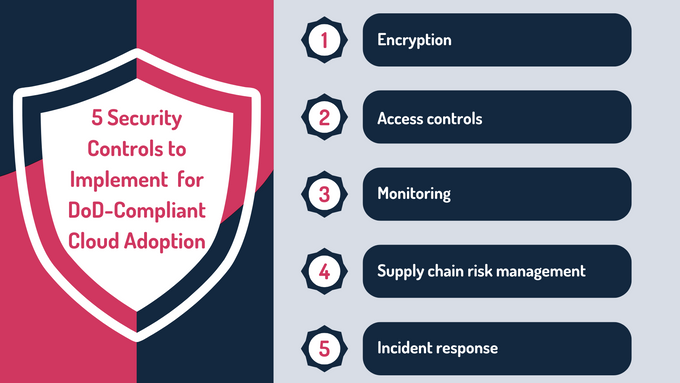
1. Encryption
Organizations should implement FIPS 140-2 validated encryption for both data-at-rest and in-transit. It’s also crucial to destroy encryption keys during data spills and ensure data is restored from clean backups to maintain data integrity and security.
Depending on the circumstances, you may also want to implement symmetric and asymmetric encryption.
» Did you know that attackers use encryption as well? Here's how to deal with ransomware
2. Access Controls
Zero trust architecture (ZTA) plays a critical role in the DoD’s cloud security strategy. This model helps ensure the integrity of the system by assuming that no device, user, or system should be trusted by default.
Key aspects include:
- Enforce strong access control: ZTA principles require rigorous access verification at every point, even for users inside the network. Multi-factor authentication (MFA) is a core component, ensuring that access requests are properly authenticated and secure.
- Continuous monitoring: ZTA mandates continuous monitoring and validation of all access requests, ensuring that no unauthorized access occurs. It supports continuous risk assessment, which aligns with DoD’s need for constant vigilance over cloud resources.
» Here are the things you should know before hiring a risk assessment provider
3. Monitoring
The FedRAMP continuous monitoring strategy and the DoD Risk Management Framework (RMF) serve as the cornerstones of continuous monitoring.
Continuous monitoring involves the ongoing, real-time evaluation of CSPs to ensure compliance with DoD security requirements.
To implement effective real-time security monitoring, organizations should:
- Establish organization-defined metrics: These metrics help track and assess security controls and overall compliance.
- Define monitoring frequencies and assessments: Organizations must establish a clear schedule for monitoring, ensuring consistency.
- Follow the continuous monitoring plan: Regular assessments should align with the organization’s predefined monitoring strategy to maintain security.
- Hire and finance a Mission CND (MCND): This ensures the protection of apps, systems, and virtual networks within the IaaS/PaaS infrastructure of any CSP.
- Use an assured compliance assessment solution (ACAS): Implement scanning and ensure all security standards are continuously verified.
» Protect yourself from internet vulnerabilities by understanding phishing attacks
4. Supply Chain Risk Management
Supply chain risk management (SCRM) is integral to the DoD’s cloud security requirements. To ensure supply chain integrity, organizations must develop a comprehensive SCRM plan that includes an anti-counterfeit strategy.
To align with SRG guidelines and ensure vendor compliance, organizations should:
- Conduct vendor assessments: Evaluate suppliers using frameworks like NIST SP 800-161 to identify risks in hardware, software, and services.
- Implement cybersecurity standards: Require vendors to adhere to CMMC and FIPS-compliant encryption protocols.
- Enforce contractual obligations: Include clauses mandating secure development practices and incident reporting in contracts.
- Leverage continuous monitoring: Use security information and event management (SIEM) tools for real-time threat detection across the supply chain.
- Collaborate on threat intelligence: Engage in programs like the Defense Industrial Base Collaborative Information Sharing Environment (DCISE) to exchange information on emerging threats.
5. Incident Response
Organizations must coordinate incident response and threat intelligence sharing across CSPs, CND entities, and mission owners to defend DoD systems. This shared responsibility ensures quick detection, reporting, and mitigation of security threats.
To comply with FedRAMP and DoD guidelines, organizations need an incident response plan addendum that addresses integration and data breaches. This addendum should meet SRG reporting requirements and be reviewed by DISA.
Incident reporting obligations under the SRG include:
- Incident reporting to MCND: CSPs must report incidents to the MCND, which coordinates with the BCND as necessary.
- Initial incident reports: These must be submitted within one hour of discovery, with follow-up information provided as it becomes available.
- US-CERT reporting lexicon: Reports should align with the reporting standards established by US-CERT.
- Incident response plan or addendum: CSPs must provide a plan or addendum addressing data breaches and ensuring government notification.
- Incident reporting for dedicated DoD infrastructure: Incidents must be reported directly to the DoD.
- Incident reporting in multi-tenant environments: Incidents must be reported to both US-CERT and the DoD.
Take Note: Recent updates to the DoD Cloud Computing SRG include the shift from NIST SP 800-53 Rev 4 to Rev 5 and alignment with CNSSP-32. The SRG now splits into two documents:
- DoD CSP SRG
- DoD Mission Owner SRG
Organizations must ensure they follow new reciprocity between FedRAMP and DoD impact levels and understand increased penetration testing rights in IL6 environments to maintain compliance and support DoD missions.
» Learn more about the different types of penetration testing and the key pentesting steps
Securing Cloud Adoption for DoD Compliance
GRSee Consulting can help your organization navigate the complex requirements of secure cloud adoption in the DoD. Adhering to the stringent guidelines outlined in the CC SRG and DoD SRG is essential. By implementing robust security controls such as encryption, access controls, continuous monitoring, and incident response protocols, organizations can ensure they meet these standards.
This approach not only safeguards sensitive data but also aligns with the overall security strategy for supporting DoD missions and maintaining operational integrity.
» Ready to navigate DoD cloud authorization? Schedule a compliance assessment to map your path from current state to Provisional Authorization
FAQs
What is a DoD Provisional Authorization (PA)
A DoD Provisional Authorization (PA) is a temporary approval granted to a cloud service provider (CSP) that demonstrates compliance with DoD Security Requirements Guide (SRG) controls for a specific impact level.
The PA allows the DoD to use the cloud service while the provider completes a full Authorization to Operate (ATO). It ensures that sensitive data is protected under approved security controls and provides an interim risk management approach.
What is the difference between FedRAMP and DoD SRG?
FedRAMP provides standardized cloud security assessment and authorization for U.S. federal agencies. The DoD Security Requirements Guide (SRG), however, adds additional controls specific to DoD operations, focusing on sensitive and classified data.
While FedRAMP authorization is often a prerequisite, DoD SRG includes stricter requirements, such as physical separation for higher impact levels (IL4/IL5) and specialized personnel vetting. Essentially, FedRAMP ensures baseline security compliance, while DoD SRG addresses mission-critical requirements unique to defense workloads.
What is the difference between IL4 and IL5?
IL4 and IL5 differ primarily in the sensitivity of data and required security measures. IL4 handles moderate-impact CUI with FedRAMP Moderate controls plus DoD-specific enhancements, including access management and logging. IL5 is intended for sensitive CUI needing additional protection, including physically isolated infrastructure, stricter encryption, and U.S. citizen personnel requirements.
IL5 workloads demand higher operational rigor and cost due to these additional safeguards, while IL4 allows multi-tenant cloud environments with enhanced logical separation.
What is DISA's role in DoD cloud authorization?
The Defense Information Systems Agency (DISA) oversees DoD cloud authorization. It evaluates CSPs against SRG requirements, issues PAs, and grants ATOs. DISA ensures that cloud services meet the required security standards for each impact level.
How long does DoD cloud authorization take?
A PA can take a few weeks to months; a full ATO may take six months or longer. Delays are usually due to missing documentation or incomplete control implementation. Pre-assessments and close coordination with DISA can speed up the process.
Do contractors need FedRAMP authorization to work with DoD?
Yes, contractors usually need FedRAMP authorization for the relevant impact level before DoD approval. FedRAMP establishes baseline compliance, making the PA and ATO process smoother, especially for moderate or higher IL workloads.
What does FedRAMP equivalent mean for DoD contractors?
“FedRAMP equivalent” means a CSP meets the baseline FedRAMP requirements without formal authorization. DoD contractors still need to comply with SRG controls for the specific IL to receive a PA or ATO.