How to Conduct a Thorough SOC 2 Gap Assessment: Fortify Your Security
A SOC 2 gap assessment is crucial for identifying gaps before a the official audit. Follow our guide to strengthen your security controls and achieve SOC 2 compliance.




Published August 20, 2026
AI Summary


Conducting a thorough SOC 2 gap assessment helps organizations strengthen their security and ensure compliance. This evaluation provides the necessary groundwork for the official SOC 2 audit by identifying gaps in security controls.
In this guide, we’ll walk you through the steps to perform a comprehensive gap assessment and fortify your organization's security posture.
» Let the experts handle your SOC 2 compliance with our startup and enterprise services
SOC 2 Gap Assessment vs. SOC 2 Audit
A SOC 2 gap assessment is a preliminary evaluation that identifies areas where an organization's controls might not meet SOC 2 standards, essentially highlighting areas for improvement before a full SOC 2 audit.
On the other hand, a SOC 2 audit is a comprehensive evaluation by a certified CPA auditor that verifies whether an organization's controls meet SOC 2 compliance requirements, providing a format report on their security posture.

» Not sure about SOC 2? Compare SOC 2 to ISO 27001
Advantages of SOC 2 Certification for Risk Management
- Builds trust: SOC 2 certification shows potential clients that your data security practices meet independent standards, assuring them that their information is safe with you.
- Meets regulatory requirements: Many industries now require SOC 2 report, and having it ensures you meet these security standards, sometimes even as a condition for partnership.
- Improves internal processes: The SOC 2 audit process helps identify and fix system weaknesses, strengthening your security and improving operational efficiency.
- Provides a competitive edge: SOC 2 report sets you apart from competitors by showcasing your commitment to security and professionalism.
» Learn more about SOC 2: Our guides to SOC 2 Type 1 compliance and SOC 2 Type 2 compliance
Professional SOC 2 Services
Continuously monitor security controls for compliance
Achieve SOC 2 Type 1 & 2 compliance with expert auditing
Regularly update documentation to match organizational changes
How to Prepare for a SOC 2 Gap Assessment
- Choose your auditor: It's best to work with a qualified Certified Public Accountant (CPA) firm that has a deep understanding of security practices and proven experience as official SOC 2 auditors. Firms like GRSee, which specialize in this area, can provide valuable insights and ensure a smooth and effective assessment process.
- Identify the type of SOC 2 report you need: Choose between (evaluating the design of controls) and (assessing effectiveness over time).
- Define your audit scope: Where the scope of the audit is not defined, scope creep is inevitable in the form of adding new systems or services to the assessment without prior planning or including additional personnel or processes and will invariably lead to resource wastage. Be sure to clearly define the systems, applications, infrastructure, and data included in the assessment.
» Read more about the merits of adopting SOC 2
Critical Areas to Evaluate in a SOC 2 Gap Assessment
Before conducting a SOC 2 gap assessment, it’s important to know the critical areas to evaluate in your organization’s control environment. These areas help identify any gaps or weaknesses in your security and compliance controls.
- Security: Assess controls related to protecting information from unauthorized access, disclosure, or disruption. This includes physical security, network security, and access controls.
- Availability: Evaluate measures that ensure systems and information are available for operation and use as committed or agreed upon. This includes system redundancy, backup processes, and disaster recovery plans.
- Processing integrity: Examine controls that ensure data processing is complete, accurate, timely, and authorized. This involves validation processes, error detection, and correction mechanisms.
- Confidentiality: Review controls that protect sensitive information from unauthorized access or disclosure. This includes encryption, data classification, and access restrictions.
- Privacy: Assess controls that protect personal information from unauthorized access or disclosure. This includes data minimization, consent management, and data retention policies.
- Risk management: Evaluate the organization's process for identifying, assessing, and managing risks related to the SOC 2 gap assessment requirements.
- Monitoring: Check the effectiveness of ongoing monitoring processes to ensure that controls are functioning as intended and to detect any anomalies or incidents.
- Incident response: Assess the organization's ability to respond to and recover from security incidents, including incident detection, reporting, and remediation.
- Change management: Evaluate controls related to managing changes in systems and processes to ensure they do not negatively impact security or compliance.
- Employee training: Review training programs to ensure employees are aware of documented security policies, procedures, and their responsibilities.
» Learn more about the disasters you can avoid by tackling cybersecurity on time
Step-by-Step Guide to Performing a SOC 2 Gap Assessment
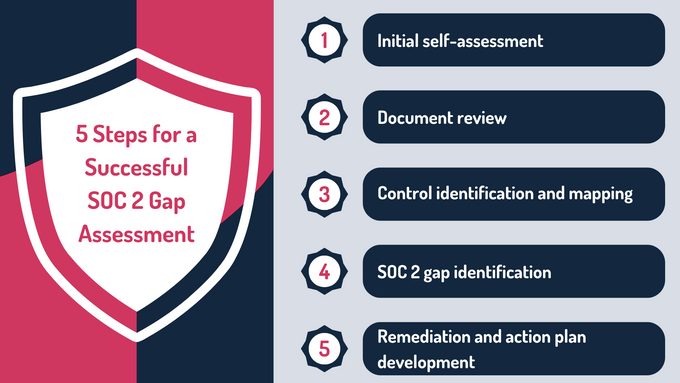
1. Initial Self-Assessment
Security is the only mandatory trust services criteria (TSC) for a SOC 2 report. The others are optional and can be included based on what’s relevant to your organization or valuable to report stakeholders. These are:
- Security (mandatory)
- Availability (optional)
- Processing integrity (optional)
- Confidentiality (optional)
- Privacy (optional)
2. Documentation Review
Here, you review your organization’s existing policies, procedures, and controls documentation. This review process helps you identify what is already in place and what needs improvement.
3. Control Identification and Mapping
At this point, you map your existing controls to the SOC 2 requirements to see which criteria are already being met and which are not. This step involves thoroughly examining the five SOC 2 TSC and how your systems relate to the categories.
4. SOC 2 Gap Identification
Gap identification is the most important step in the SOC 2 gap assessment—it’s the reason you are analyzing gaps in the first place. The main goal of the analysis is to:
- Identify gaps in your systems and internal controls.
- Highlight discrepancies between the current state and SOC 2 compliance requirements.
- Pinpoint areas where your organization's practices fall short of compliance.
- Stress whether or not a risk assessment is needed.
5. Remediation and Action Plan Development
This stage of the analysis is vital for successful completion. For each identified gap, you need to:
- Outline specific steps or controls that must be implemented or improved.
- Assign a team or individual responsible for each remediation action and document who is responsible for what.
- Ensure each team or individual has the necessary resources and authority to implement the changes.
- Establish realistic due dates for completing each remediation step, keeping in mind the overall timeline for achieving SOC 2 compliance.
» Simplify SOC 2 compliance with our expert guidance
Checklist of Key Deliverables in a SOC 2 Gap Assessment
Gap Analysis Report
- The gap analysis report outlines the current state of your organization’s controls in comparison to the SOC 2 Trust Service Criteria.
- To document this, use a Gantt chart (a horizontal bar chart) or pictorial graph (using pictures or symbols that make it easier to understand data) to show what is in place and what still needs to be implemented. Progress can be tracked by showing work completed versus work remaining in percentage terms.
Action Plan
- The action plan identifies the gaps and deficiencies found during the assessment and provides recommended actions to address them.
- This can be documented in a table format, including columns for the gap number, issue description, recommended action, responsible personnel, resources required, and estimated completion time.
Control Implementation Plan
- This is a roadmap for implementing the necessary controls to meet SOC 2 requirements.
Compliance Roadmap
- This is a timeline for achieving SOC 2 compliance, including key milestones and deadlines.
- The compliance roadmap should be reported to stakeholders using infographics.
How GRSee Consulting Can Support Your SOC 2 Gap Assessment
At GRSee Consulting, we guide you through a comprehensive SOC 2 gap assessment using industry best practices—helping you define the scope clearly, align with the Trust Services Criteria, and maintain proper documentation at every stage. We help identify and prioritize gaps, develop actionable remediation plans, and support you throughout the process so your organization stays aligned with SOC 2 requirements.
After completing the gap assessment and remediation work, our team performs the SOC 2 audit procedures and manages the engagement, while an independent CPA conducts the examination and issues the final SOC 2 report.
Whether you’re just beginning the assessment or need support throughout remediation and the CPA-led examination, GRSee provides the expertise, structure, and high-touch guidance to streamline your path toward SOC 2 compliance.
» Ready to reach SOC 2 compliance? Contact us
SOC 2 Gap Assessment: FAQs
What is the difference between a SOC 2 gap assessment and a SOC 2 audit?
A SOC 2 gap assessment is a pre-audit evaluation that helps identify missing or insufficient controls before the formal audit begins. It’s an internal step to prepare your organization. A SOC 2 audit, on the other hand, is a formal, independent evaluation performed by a certified auditor that results in an official SOC 2 report.
Who should perform the SOC 2 gap assessment?
While your internal security or compliance personnel can initiate a gap assessment, it's highly recommended to work with an experienced third-party advisor or SOC 2 readiness consultant. Their insight helps ensure nothing critical is overlooked before the audit phase.
Which Trust Services Criteria are required for a SOC 2 assessment?
Only Security is mandatory. The other criteria—Availability, Processing Integrity, Confidentiality, and Privacy—are optional and should be included based on your organization’s services and stakeholder expectations.
What happens after gaps are identified?
Once gaps are found, your organization should develop a remediation and action plan. This involves assigning responsibilities, setting deadlines, and implementing the missing or insufficient controls before moving to the formal audit.